
Zoology, or the science and scientific study of animals, is a branch of biology that studies the structure, physiology, development, classification and behaviour of animals in their natural habitats. As one of the oldest biological sciences, zoology plays a crucial role in understanding how animals interact with each other, with humans and with their environment.
Studying animal life gives us insights into the balance of nature and the importance of biodiversity in maintaining healthy ecosystems. It helps scientists, students and educators to identify species, understand animal adaptations and find out the impact of environmental changes on wildlife. This knowledge is essential for conservation, wildlife management and protecting endangered species.
In this fast changing world, Introduction to Zoology is the first step in exploring the animal kingdom – from the smallest invertebrates to the largest mammals. For students, it’s a foundation for further biological studies; for teachers, it’s a framework to spark curiosity and scientific thinking.
Definition and Scope of Zoology
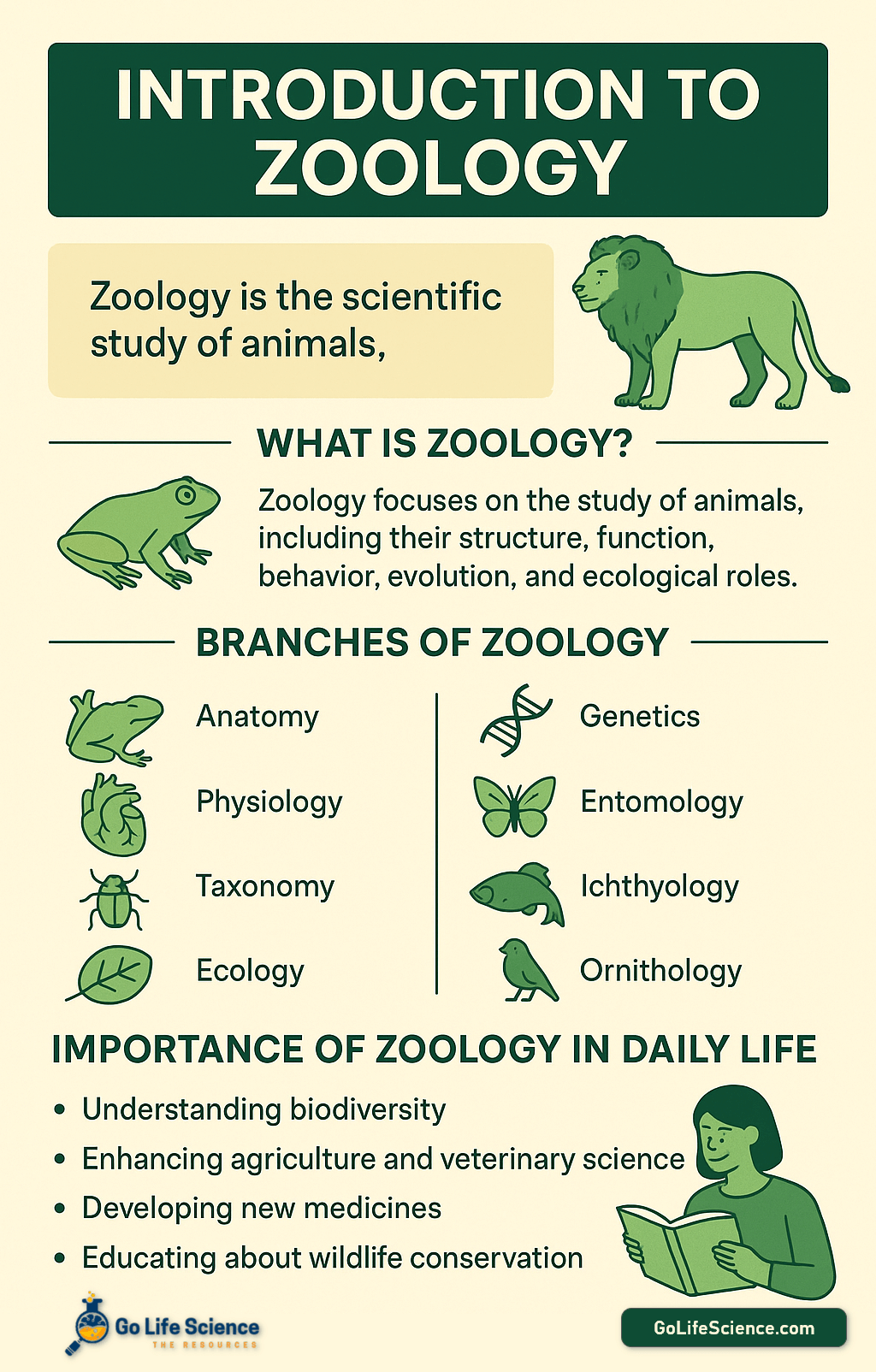
Zoology is the branch of biology that focuses on the study of animals, including their structure, function, behavior, evolution, and ecological roles. The term comes from two Greek words:
- “Zoon” meaning animal
- “Logos” meaning study or discourse
In simple terms, zoology is the scientific study of all aspects of animal life, from tiny microscopic organisms to large mammals.
Scope of Zoology
The scope of zoology is vast and covers multiple aspects of animal life. It is essential for understanding biodiversity, conservation, and human-animal relationships. Below are the main areas:
- Animal Anatomy and Physiology – Study of the structure and function of animal organs and systems.
- Animal Behavior (Ethology) – Observing how animals interact with their environment, other animals, and humans.
- Classification and Taxonomy – Identifying, naming, and organizing animals into groups based on similarities.
- Evolutionary Biology – Understanding how animals have evolved over millions of years.
- Ecology – Studying the relationship between animals and their habitats.
- Genetics and Molecular Biology – Exploring the genetic makeup of animals and how traits are inherited.
- Conservation Biology – Protecting endangered species and preserving biodiversity.
- Parasitology and Pathology – Studying animal diseases, parasites, and their impacts.
Why Study Zoology?
- To understand biodiversity and protect endangered species.
- To enhance agriculture and veterinary science through animal health research.
- To develop new medicines using animal-based studies.
- To educate future generations about the importance of wildlife conservation.
Branches of Zoology
Zoology is a vast subject, and to make its study easier, it is divided into several specialized branches.
Each branch focuses on a particular aspect of animal life, from their smallest cells to their interaction with the environment.
Understanding these branches helps students and researchers focus on specific areas of interest within the animal kingdom.
Letus explore the branches of zoology.
| Branch of Zoology | Description | Examples / Applications |
|---|---|---|
| Anatomy | Study of the structure and organization of animals, both external and internal. | Comparative anatomy of mammals, bird skeleton studies. |
| Physiology | Study of the functions and processes of animal organs and systems. | Respiratory function in fish, muscle physiology in humans. |
| Ecology | Study of interactions between animals and their environment. | Wildlife conservation, habitat management. |
| Taxonomy | Classification and naming of animals into hierarchical groups. | Naming new species, revising animal classifications. |
| Genetics | Study of heredity, variation, and genes in animals. | Genetic mapping of species, breeding programs. |
| Entomology | Study of insects. | Pest control, pollinator conservation. |
| Ichthyology | Study of fishes. | Marine fish research, aquaculture studies. |
| Ornithology | Study of birds. | Bird migration tracking, avian biodiversity studies. |
| Herpetology | Study of reptiles and amphibians. | Snake venom research, amphibian population studies. |
| Mammalogy | Study of mammals. | Mammal behavior research, wildlife photography documentation. |
Importance of Zoology in Daily Life
Zoology plays a crucial role in understanding the natural world and maintaining the balance between humans and animals. Its applications extend beyond academic studies, influencing health, agriculture, conservation, and even technology. For students and teachers, understanding the practical benefits of zoology bridges the gap between theory and real-world impact.
- Contribution to Wildlife Conservation: Zoologists play a critical role in protecting biodiversity. By studying animal behavior, habitats, and population trends, they help design conservation strategies to save endangered species such as tigers, rhinos, and sea turtles. Wildlife conservation efforts also maintain ecosystem balance, which is essential for a healthy planet.
- Role in Medicine and Veterinary Science: Research in zoology often leads to medical breakthroughs. For example, studying the physiology of certain animals helps develop new drugs, vaccines, and surgical techniques. Veterinary science—an important branch of zoology—ensures the health and welfare of domestic and farm animals, preventing diseases that could spread to humans (zoonotic diseases).
- Importance in Agriculture and Pest Control: Many zoologists specialize in agricultural zoology to boost crop production and protect food supplies. They study beneficial species like pollinators (bees, butterflies) and natural pest controllers (ladybugs, birds). Zoology research also develops eco-friendly pest management techniques, reducing the need for harmful chemical pesticides.
- Understanding Environmental Changes: Zoologists help track the effects of climate change, pollution, and habitat destruction on animal populations. Their studies reveal early warning signs of environmental problems—such as the migration changes in birds or coral reef bleaching—allowing for timely conservation actions.
| Aspect | Importance in Daily Life |
|---|---|
| Healthcare | Helps in understanding animal-borne diseases, developing vaccines, and improving public health. |
| Agriculture | Guides in pest control, livestock management, and sustainable farming practices. |
| Environmental Conservation | Assists in protecting endangered species and maintaining biodiversity. |
| Food Industry | Supports aquaculture, poultry farming, and ethical food production. |
| Scientific Research | Provides models for studying genetics, physiology, and behavior. |
| Education | Encourages awareness about wildlife, ecology, and sustainable living. |
History and Development of Zoology
Zoology, as a branch of science, has evolved over thousands of years — from simple observations of animals in ancient times to modern research using advanced technology. Understanding its history helps us appreciate the journey of discovery that shaped our current knowledge.
1. Ancient Beginnings
- Egyptians and Mesopotamians (around 3000 BCE) recorded observations of domestic and wild animals for agriculture, hunting, and religious purposes.
- Indian texts like the Rigveda and Charaka Samhita described animals and their roles in medicine and mythology.
- Greek philosophers such as Aristotle (384–322 BCE) systematically studied and classified animals, laying the foundation of zoological science.
2. Middle Ages
- In the medieval period, zoology was influenced by religion and philosophy.
- Islamic scholars like Al-Jahiz wrote about animal behavior and ecology.
- Animal descriptions often mixed facts with myths, due to limited exploration and experimentation.
3. Renaissance (14th–17th Century)
- Revival of scientific thinking led to more accurate observations and illustrations.
- Naturalists like Conrad Gesner compiled detailed encyclopedias of animal life.
- Exploration of new continents introduced Europeans to previously unknown species.
4. Modern Era (18th–19th Century)
- Carl Linnaeus (1707–1778) introduced the binomial nomenclature system for naming species, which is still used today.
- Charles Darwin (1809–1882) revolutionized biology with his theory of evolution by natural selection.
- Advancements in microscopy allowed scientists to study animal cells and tissues.
5. Contemporary Zoology (20th Century–Present)
- Molecular biology and genetics have expanded our understanding of animal diversity and evolution.
- Conservation biology emerged to protect endangered species.
- Technology such as satellite tracking, DNA sequencing, and AI-based analysis has transformed animal research.
Quick Timeline of Zoology Development
| Period | Key Contributions | Notable Figures |
|---|---|---|
| Ancient Civilizations | Early animal observations, domestication, medicinal uses | Egyptians, Aristotle |
| Middle Ages | Preservation of classical knowledge, early ecology ideas | Al-Jahiz, Medieval scholars |
| Renaissance | Scientific illustrations, species cataloging | Conrad Gesner |
| Modern Era | Classification system, evolutionary theory | Carl Linnaeus, Charles Darwin |
| Contemporary Era | Genetics, conservation, technological tools | Modern biologists |
Methods Used in Zoological Studies
Zoologists and wildlife researchers use a variety of scientific methods to study animals, their behavior, anatomy, and interactions with the environment. The following are the main methods of study in zoology:
1. Field Studies and Observation
Fieldwork is one of the most fundamental methods in zoological research. It involves observing animals in their natural habitat to understand their behavior, feeding habits, migration patterns, and reproductive cycles. Techniques include:
- Direct observation using binoculars or spotting scopes.
- Camera traps for nocturnal or elusive animals.
- Long-term monitoring for wildlife conservation studies.
Field studies provide real-world data that laboratory experiments may not capture, making them essential in ecological and behavioral zoology.
2. Laboratory Experiments
Laboratories allow zoologists to study animals under controlled conditions, helping researchers test hypotheses and study biological processes. Common laboratory methods include:
- Controlled breeding experiments.
- Studying the effects of environmental changes on animal physiology.
- Behavioral experiments to analyze response to stimuli.
This method is crucial for animal physiology, genetics, and developmental biology research.
3. Dissection and Anatomical Studies
Dissection has long been used in zoology to study animal anatomy and understand the structure and function of different organ systems. It helps in:
- Comparative anatomy between species.
- Understanding adaptations in different environments.
- Identifying evolutionary relationships.
With modern ethics and technology, 3D anatomy models and virtual dissections are now increasingly used for student training.
4. Use of Technology in Zoology
Modern zoological research heavily relies on advanced technology to collect, analyze, and interpret data. Some examples include:
- DNA analysis for studying genetics, evolutionary biology, and species identification.
- GPS tracking devices to monitor animal migration and habitat use.
- Artificial Intelligence (AI) for processing large datasets, such as image recognition in camera trap studies.
- Remote sensing and drones for mapping habitats and studying inaccessible regions.
Technology has revolutionized zoology, enabling researchers to gather accurate and non-invasive data for wildlife conservation and biodiversity management.
Career Opportunities in Zoology
A degree in zoology opens up a wide range of rewarding career paths for students passionate about animals, biodiversity, and the environment. Graduates can work as zoologists, wildlife biologists, marine biologists, ecologists, or conservation scientists, applying their expertise in both fieldwork and laboratory research.
Many zoologists find employment in research institutions and universities, contributing to scientific studies on animal behavior, genetics, and ecology. Teaching careers in schools, colleges, and higher education allow zoologists to inspire the next generation of scientists.
The field also offers opportunities in wildlife conservation organizations, environmental management agencies, and non-governmental organizations (NGOs) focused on protecting endangered species and restoring ecosystems. Government agencies such as the Forest Department, Fisheries Department, and Environmental Protection bodies employ zoologists for policy development, species monitoring, and habitat management.
For those interested in specialized fields, careers in zoo management, aquatic resource management, pest control, veterinary research, animal health inspection, and ecotourism are growing steadily. Zoologists with advanced degrees may also pursue roles in biotechnology, wildlife forensics, or environmental consulting.
With the rising global demand for biodiversity conservation and sustainable wildlife management, zoology graduates have a bright future in both public and private sectors worldwide
Challenges and Future of Zoology
Zoology, like all life sciences, faces both complex challenges and promising opportunities as it advances in the 21st century. The discipline is evolving rapidly due to global environmental changes, technological breakthroughs, and shifting conservation priorities.
1. Major Challenges in Zoology
The modern world presents several critical threats to animal life and the ecosystems they depend on:
- Habitat Loss and Fragmentation – Rapid deforestation, urban expansion, and conversion of natural habitats into agricultural land are leading to a dramatic decline in wildlife populations. Species that require large, connected territories—such as tigers and elephants—are most at risk.
- Climate Change and Global Warming – Rising global temperatures are altering animal migration patterns, breeding cycles, and species distribution. Many polar and alpine species face extinction as their habitats shrink.
- Biodiversity Decline – The sixth mass extinction is underway, with thousands of species threatened by overexploitation, illegal wildlife trade, and pollution.
- Invasive Species – The introduction of non-native species disrupts local ecosystems, leading to competition, predation, and sometimes the extinction of native species.
- Environmental Pollution – Plastic waste, chemical runoff, and ocean acidification are impacting marine and terrestrial species alike, disrupting food chains and reproductive success.
2. Emerging Fields and Technological Advancements
Despite these challenges, zoological research is entering a revolutionary era:
- Bioinformatics in Zoology – The use of big data, AI-driven analytics, and machine learning allows researchers to process vast amounts of ecological and genetic information, improving wildlife monitoring and conservation strategies.
- Genetic Engineering and CRISPR Technology – Scientists can now edit animal genomes, offering potential solutions for disease resistance, species revival (de-extinction), and biodiversity restoration.
- Conservation Genomics – DNA analysis is helping identify genetic bottlenecks in endangered species, guiding more effective breeding programs.
- Wildlife Tracking and Remote Sensing – Satellite tracking, camera traps, and drones are revolutionizing field research, enabling non-invasive and real-time animal observation.
- Eco-physiology Studies – Understanding how animals adapt to environmental changes can help predict species survival in a warming world.
3. The Future of Zoology
Looking ahead, zoology will need to adapt to emerging environmental and societal pressures:
- Integrating Interdisciplinary Research – Collaboration between ecologists, biotechnologists, and climate scientists will be essential for tackling complex environmental problems.
- Public Engagement and Citizen Science – Digital platforms and mobile applications can empower the public to participate in wildlife data collection, enhancing large-scale biodiversity monitoring.
- Policy-Driven Conservation – Zoologists will play a vital role in shaping environmental policies, wildlife protection laws, and sustainable development initiatives.
- Focus on Sustainable Coexistence – The goal will be to ensure human development progresses without compromising the survival of other species.
In summary, the future of zoology lies in combining traditional fieldwork with cutting-edge technology to protect biodiversity and maintain ecological balance. The field’s evolution will not only depend on scientific advancements but also on global collaboration and environmental awareness.
Conclusion: Why Zoology Matters in Science and Society
Zoology is key to understanding animal life from microorganisms to mammals. By studying animal behaviour, anatomy, physiology and ecology zoologists help solve problems like wildlife conservation, endangered species protection and ecosystem management.
This branch of biological sciences not only helps us understand diversity of life but also supports veterinary medicine, environmental protection and biodiversity research. With climate change, habitat loss and human-wildlife conflict on the rise, the need for zoologists and researchers has never been greater.
If you love animals and the natural world, a career in zoology can open doors to exciting opportunities in research institutions, universities, wildlife sanctuaries and environmental organisations. Whether your interest is in marine biology, ornithology, entomology or zoo management, zoology has many specialisations that can make a difference.
🔍 Next step: Check out zoology courses, volunteer in conservation programs or participate in citizen science projects. Every bit helps to protect our planet’s animal heritage for future generations.
Frequently Answered Questions on Introduction to Zoology
What is the main focus of zoology?
The main focus of zoology is the scientific study of animals, including their anatomy, physiology, behavior, evolution, and ecological roles. Zoologists explore everything from microscopic invertebrates to large mammals, aiming to understand species diversity, habitat relationships, and adaptation mechanisms.
Who is known as the father of zoology?
Aristotle is often referred to as the “Father of Zoology” due to his pioneering work in classifying and studying animal species. His detailed observations and systematic classification laid the foundation for modern animal biology and taxonomy.
How is zoology different from biology?
While biology is the broad study of all living organisms, zoology is a specialized branch that focuses exclusively on the animal kingdom. Zoology delves deeper into animal physiology, reproduction, taxonomy, and interactions within ecosystems, making it a subset of biological sciences.
Can zoology help in environmental conservation?
Yes. Zoology plays a crucial role in environmental conservation by providing insights into species behavior, population dynamics, and habitat requirements. Zoologists work on wildlife protection programs, endangered species conservation, and ecological restoration projects to maintain biodiversity and ecosystem balance.
What is zoology and why is it important?
Zoology is the branch of biology that studies animals, their structure, physiology, behavior, and classification. It’s important because it helps us understand biodiversity, protect endangered species, and maintain ecological balance.
What is the difference between zoology and veterinary science?
Zoology focuses on the study of animals in their natural habitats, while veterinary science is about treating and caring for animals. Zoologists may work in research, whereas veterinarians focus on animal health and medicine.
What tools and techniques do zoologists use?
Zoologists use tools like binoculars, GPS trackers, microscopes, camera traps, and laboratory equipment. They also use DNA analysis, behavioral observation, and ecological surveys to study animals.
How long does it take to become a zoologist?
It typically takes 4 years to earn a bachelor’s degree in zoology or related fields. Advanced research roles may require a master’s degree or PhD, adding 2–6 more years.
Can zoology be studied online?
es. Many universities offer online zoology courses and wildlife biology programs. These may include virtual lectures, interactive labs, and field assignments.
How is marine biology related to zoology?
Marine biology is a specialized branch of zoology that studies ocean animals and their environments. While zoology covers all animals, marine biology focuses on species living in saltwater ecosystems.
Discover more from Go Life Science
Subscribe to get the latest posts sent to your email.
