Botany, also known as plant science or plant biology is a major branch of biology that deals with the scientific study of plants. From tiny microscopic algae to towering trees, the field studies plants at multiple levels — their cellular structure, genetic makeup, growth patterns, reproductive methods, metabolism, diseases and their role in ecosystems.
Plants are the backbone of life on Earth. They produce oxygen through photosynthesis, are the primary source of food for most living organisms and form the basis of terrestrial food chains. Without plants, humans and animals cannot survive as plants provide:
- Food (grains, fruits, vegetables, seeds etc.)
- Raw materials (wood, fibers, oils)
- Medicines (herbal drugs, plant based compounds)
- Environmental services (oxygen production, carbon dioxide absorption, climate regulation)
Botany as a science is not just about identifying and naming plants but also about understanding how they function, how they interact with the environment and how humans can use and conserve them. In modern times botany integrates with advanced fields like genetics, biotechnology and environmental science to solve challenges like food security, biodiversity loss and climate change.
Studying botany gives students knowledge that can be applied in:
- Agriculture: improving crop quality and yield.
- Pharmaceuticals: developing new plant based medicines.
- Conservation Biology: protecting endangered plant species.
- Bioenergy: producing renewable fuels from plant materials.
Why it matters: Plants form the basis of life on Earth — they produce oxygen, store energy in food, and maintain ecosystems.
In short botany is both a traditional and modern science, rooted in centuries old plant studies but evolving with cutting edge technology to address present day global challenges.
Definition and introduction to Botany
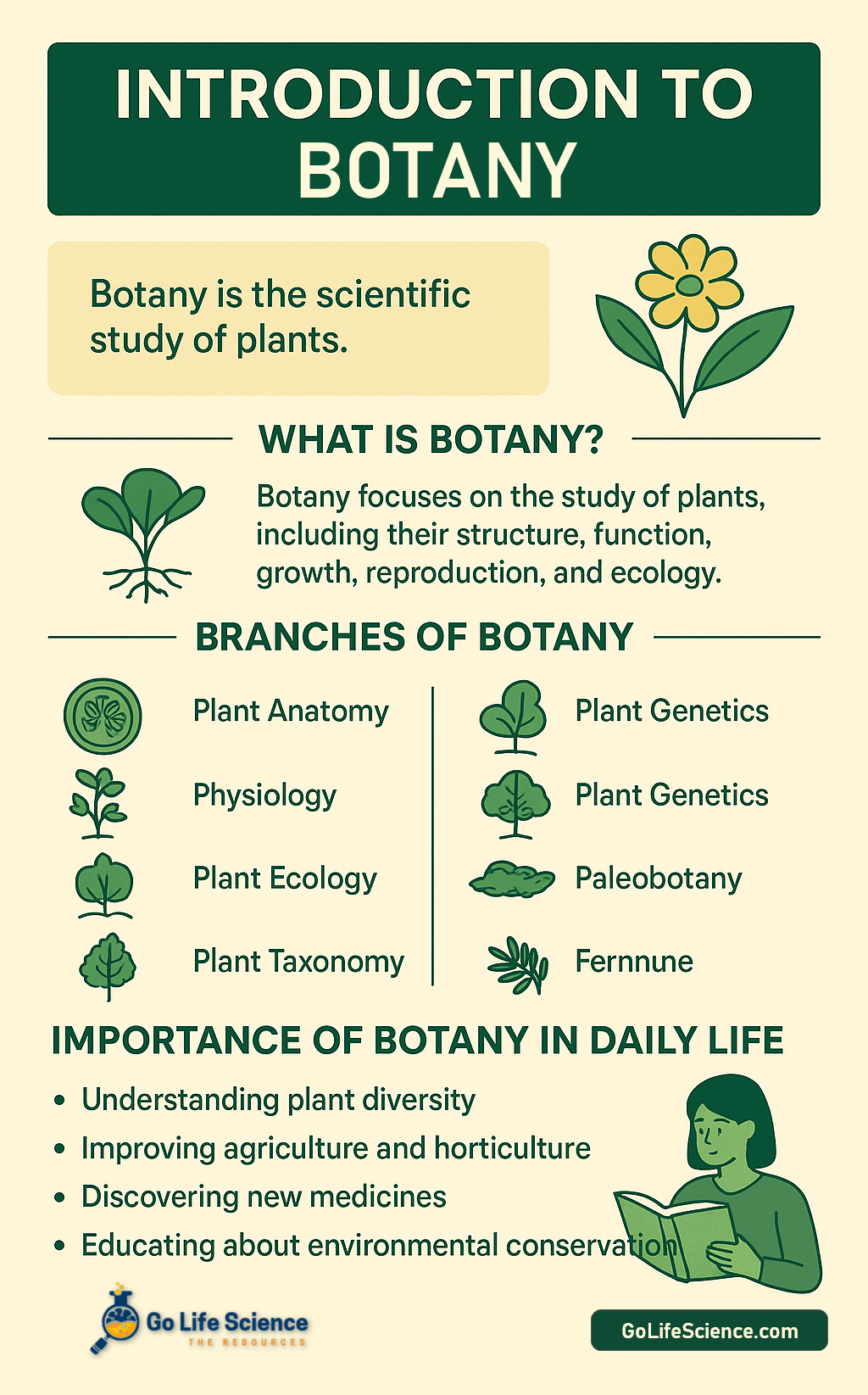
Botany is the scientific study of plants which includes algae, fungi-like plants, mosses, ferns, gymnosperms (cone-bearing plants) and angiosperms (flowering plants).
The term Botany comes from the Greek word “botanē” meaning plant or pasture. It was first used in ancient Greece where plants were studied mainly for their medicinal, edible and agricultural value. Today botany goes beyond traditional plant descriptions — it studies plants at molecular, cellular, organism and ecosystem levels.
In simple terms botany is to plants what zoology is to animals — a field that seeks to understand their life processes, structures and interactions with the world.
Examples:
- When a scientist studies how a sunflower turns towards sunlight, they are studying plant physiology.
- When a researcher identifies a new species of orchid, they are working in plant taxonomy.
- When agricultural scientists develop drought-resistant rice, they are applying botanical research in plant biotechnology.
Competitive Exam Relevance
In many biology-based competitive exams (NEET, CSIR NET, ICAR, etc.) the definition of botany often comes with related MCQs such as:
- “Who is known as the Father of Botany?” (Answer: Theophrastus)
- “What is the study of algae called?” (Answer: Phycology)
- “Botany is derived from which Greek word?” (Answer: Botanē)
So understanding the definition and scope of botany is the foundation to explore its various branches and applications.
Historical Background of Botany
- Ancient Period → Herbal knowledge recorded in ancient texts from India, China, and Egypt.
- Classical Period → Theophrastus wrote Enquiry into Plants (~300 BCE).
- Middle Ages → Monks and scholars preserved plant knowledge for medicine.
- Modern Era → Invention of microscopes & genetics revolutionized plant study.
Scope of Botany
The scope of botany is vast, covering everything from microscopic plant cells to entire ecosystems. It connects traditional plant studies with modern research areas like biotechnology and climate science.
Botany is generally divided into several sub-disciplines, each focusing on a specific aspect of plant life.
| Sub-discipline | Focus Area | Example Applications |
|---|---|---|
| Plant Anatomy | Internal structure of plants (tissues, cells) | Identifying tissue damage in plant diseases |
| Plant Morphology | External form and structure | Studying root types in crop plants |
| Plant Physiology | Functions and processes (photosynthesis, respiration) | Enhancing crop growth using hormones |
| Plant Taxonomy | Naming and classification of plants | Identifying a new orchid species |
| Ecology | Plant-environment interactions | Studying effects of pollution on forests |
| Palaeobotany | Fossil plants and ancient vegetation | Reconstructing past climates from fossil evidence |
| Economic Botany | Practical uses of plants in human life | Developing plant-based biofuels |
| Ethnobotany | Relationship between people and plants in culture | Documenting medicinal plant use in tribal areas |
| Plant Pathology | Study of plant diseases | Controlling fungal infections in crops |
| Phycology | Study of algae | Producing algae-based nutritional supplements |
Why the Scope is Important for Students
- Exam Relevance → Many biology exams ask direct questions about these sub-disciplines.
- Career Orientation → Knowing the scope helps students choose specializations.
- Practical Understanding → Links plant science to real-world uses like agriculture, medicine, and industry.
Example Competitive Exam Question:
Q: The study of algae is called:
a) Mycology
b) Phycology
c) Bryology
d) Pteridology
Answer: b) Phycology
Importance of Botany
Botany is not just a theoretical science — it has direct impacts on human life, the environment, and the global economy. Understanding plants is essential for food security, environmental sustainability, and medical innovation.
A. In Food Production
- Plants form the base of the food chain, producing food via photosynthesis.
- Botany helps improve crop quality, yield, and disease resistance.
- Example: Development of high-yield wheat varieties during the Green Revolution.
B. In Medicine
- Over 25% of modern medicines are derived from plants.
- Example:
- Aspirin → from willow bark (Salix alba)
- Quinine → from cinchona tree (anti-malarial)
- Morphine → from opium poppy (Papaver somniferum)
- Ethnobotany documents traditional plant-based remedies for modern pharmacology.
C. In Industry
- Plants provide timber, paper, textiles (cotton, jute), oils, dyes, and more.
- Algae are now used to make biofuels and biodegradable plastics.
D. In Environmental Protection
- Forests regulate climate by absorbing carbon dioxide.
- Plants prevent soil erosion and maintain biodiversity.
- Example: Mangrove forests protect coastal areas from storms.
E. In Scientific Research
- Plants are model organisms for genetic studies (e.g., Arabidopsis thaliana).
- Studying plant responses to stress helps combat climate change effects.
F. In Culture & Aesthetics
- Plants hold symbolic value in religion, art, and festivals.
- Gardens and green spaces improve mental health and urban air quality.
Quick Competitive Exam Tip
Question: Which plant is the source of the anti-cancer drug Taxol?
Answer: Taxus brevifolia (Pacific yew).
Summary: Botany touches every aspect of life — from the food on our plates to the air we breathe, the clothes we wear, and the medicines we take. Without plants, life on Earth would simply cease to exist.
Branches of Botany
Botany is divided into several specialized branches, each focusing on a particular area of plant science. Knowing these branches helps students organize their study and understand how different fields of plant research connect.
Here is the list of branches of botany:
| Branch | Study Focus | Example |
|---|---|---|
| Plant Anatomy | Internal structure of plant organs (tissues, cells) | Studying xylem and phloem in stems |
| Plant Morphology | External form, structure, and life cycle | Comparing leaf shapes in monocots vs. dicots |
| Plant Physiology | Functional processes like photosynthesis, respiration, transpiration | Studying how light intensity affects photosynthesis rate |
| Plant Taxonomy | Classification, naming, and identification of plants | Naming a new species of orchid |
| Ecology | Interaction of plants with other organisms and environment | Studying plant adaptation in deserts |
| Palaeobotany | Fossil plants and plant evolution | Finding fossilized ferns to understand prehistoric climates |
| Economic Botany | Useful products derived from plants | Studying medicinal uses of neem |
| Ethnobotany | Cultural and traditional uses of plants | Documenting tribal herbal remedies |
| Plant Pathology | Diseases in plants and their control | Studying fungal rust in wheat |
| Phycology | Study of algae | Researching seaweed for food supplements |
| Mycology | Study of fungi (sometimes included in botany historically) | Studying edible mushrooms |
| Bryology | Study of mosses and liverworts | Observing moss adaptation in damp habitats |
| Pteridology | Study of ferns | Identifying fern species in tropical forests |
| Dendrology | Study of woody plants and trees | Cataloging tree species in a forest reserve |
| Horticulture | Cultivation of gardens, ornamental plants, and crops | Breeding new rose varieties |
| Forestry | Management and conservation of forests | Planning sustainable timber harvesting |
Why Students Should Learn the Branches
- Quick Revision Aid → Helps categorize information for exams.
- Career Guidance → Knowing branches shows possible job/research areas.
- Interdisciplinary Links → Many modern studies combine two or more branches.
Example Competitive Exam Question:
Q: Study of mosses is called:
a) Pteridology
b) Bryology
c) Mycology
d) Dendrology
Answer: b) Bryology
Modern Trends in Botany
Botany is no longer just about observing plants in nature — it now integrates advanced technologies, molecular biology, and data science to address global challenges like food security, biodiversity loss, and climate change.
A. Plant Biotechnology
- Uses genetic engineering to develop high-yield, pest-resistant, and drought-tolerant crops.
- Example: Bt cotton — engineered to resist insect pests naturally.
B. Plant Genomics & Molecular Biology
- Decoding plant DNA to understand genes controlling growth, flowering, and stress responses.
- Example: Sequencing Arabidopsis thaliana genome — a model plant for research.
C. Bioinformatics in Botany
- Using computer tools to analyze large plant genetic datasets.
- Helps in crop improvement and disease prediction.
D. Climate Change and Plant Adaptation Studies
- Research on how plants respond to heat, drought, salinity, and changing rainfall patterns.
- Example: Developing rice varieties that survive flooded or dry conditions.
E. Plant Tissue Culture
- Growing plants from a few cells in a lab — producing disease-free and fast-growing clones.
- Used in orchid cultivation, banana farming, and medicinal plant production.
F. Phytoremediation
- Using plants to clean polluted soils, air, and water.
- Example: Sunflowers removing heavy metals from contaminated land.
G. Space Botany
- Studying how plants grow in microgravity for future space farming.
- Example: NASA experiments on lettuce growth aboard the International Space Station.
Quick Competitive Exam Tip
Q: Growing plants in the absence of soil is called:
a) Aeroponics
b) Hydroponics
c) Tissue Culture
d) Mycology
Answer: b) Hydroponics
Summary: Modern botany is interdisciplinary, blending biology with technology, engineering, and environmental science. This makes it more relevant than ever for students preparing for careers in agriculture, biotechnology, environmental conservation, and research.
Conclusion on introduction of Botany
Botany is not just the study of plants — it’s the foundation of life sciences. From ancient herbal knowledge to modern genetic engineering, botany has evolved into a highly technological and research-driven field.
For students, learning botany provides:
- Conceptual clarity for biology and competitive exams
- Practical knowledge for careers in agriculture, medicine, and environment
- Awareness of the role plants play in solving global challenges like hunger, climate change, and pollution
In short: Without plants, there is no life. Without botany, we cannot fully understand or protect that life.
Biochemistry MCQ Test
📌 Student Quick Revision Notes — Introduction to Botany
| Topic | Key Points |
|---|---|
| Definition | Scientific study of plants; from Greek botanē meaning plant |
| Father of Botany | Theophrastus (Greek philosopher, 300 BCE) |
| Importance | Food, medicine, industry, environment, research |
| Branches | Anatomy, morphology, physiology, taxonomy, ecology, palaeobotany, etc. |
| Modern Trends | Biotechnology, genomics, tissue culture, climate studies, space botany |
| Competitive Exam Tip | “Study of algae” → Phycology; “Study of mosses” → Bryology |
| Example Application | Bt cotton for pest resistance, rice varieties for drought tolerance |
Final Pro Tip for Students: Start by mastering the basics of plant structure and function. Then connect them with real-life applications — this approach will make botany not only easier but also exciting.
Discover more from Go Life Science
Subscribe to get the latest posts sent to your email.